How a Simple Meet-and-Greet Tracker Helped a Pet Sitting Team Stop Losing Follow-Ups
How a Simple Meet-and-Greet Tracker Helped a Pet Sitting Team Stop Losing Follow-Ups
Meet-and-greets were being managed through different channels, calendars, conversations, and sometimes just from memory. There was no single place to see what was scheduled, cancelled, completed, who was responsible, or whether a potential client had been followed up with.
Instead of adding another expensive system, I used the tools the company already had—Google Sheets, Forms, and Calendar—to create one simple process the team could actually use.
The result was better visibility, clearer accountability, easier follow-up, and fewer questions about what happened with each lead.
The Situation
When I was supporting this pet sitting company, one thing I kept noticing was how difficult it was to know what was happening with meet-and-greets.
The information was everywhere.
Sometimes the owner knew about a meet-and-greet. Sometimes a manager had the details. Sometimes admin knew something had been scheduled, but didn't know if it happened, was cancelled, or needed a follow-up.
There were also times when notes from the meet-and-greet weren't recorded or the team simply forgot to update one another.
So when someone asked:
“What happened with this client?”
there wasn't always an easy answer.
Someone had to check the calendar, look through messages, ask a manager, or wait for another person to respond.
And if nobody remembered to follow up, there was a chance that potential client could simply disappear.
That was the bigger problem I saw.
It wasn't just about organizing appointments.
There was no clear way to track the lead from the meet-and-greet through to the next step.
What I Changed
My first thought wasn't, “They need another software.”
The client was already using Google Workspace and wasn't looking to invest in another booking or CRM platform at the time.
So I worked with what they already had.
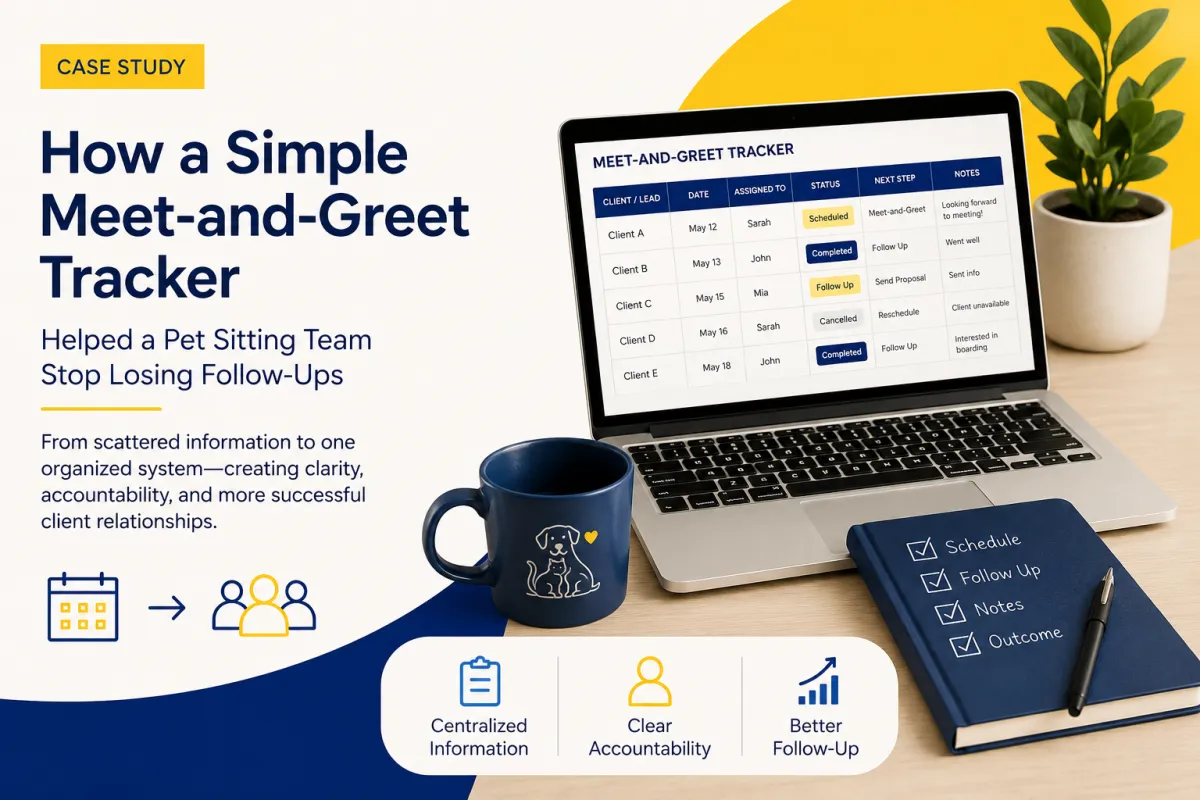
I created one shared Google Sheet that management, managers, and admin could use to see what was happening with every meet-and-greet.
Instead of information being scattered, the sheet showed the important details in one place: when the meet-and-greet was happening, who was responsible for it, its current status, follow-up information, and notes about what happened.
I also connected their existing Google Forms so information coming through those forms could feed into the same system.
Then I created a short Loom training showing the team how to use and maintain the tracker.
The goal wasn't to build something complicated.
It was to make it easy enough that people would actually keep it updated.
What Happened After
Once the tracker was in place, there was much more visibility.
Admin didn't have to constantly ask managers what happened.
Managers could see which meet-and-greets still needed attention.
There was a clear person assigned to each lead.
Cancelled appointments could be documented.
Notes had somewhere to go.
And most importantly, the team could see who still needed to be followed up with instead of relying on someone to remember.
Over time, something interesting happened.
What started as a meet-and-greet tracker naturally became a simple lead tracker for the business.
We could begin seeing the journey from potential client → meet-and-greet → follow-up → outcome.
That made the spreadsheet useful for more than scheduling. It gave the company a better view of what was actually happening with its incoming opportunities.
Why This Project Matters to Me
This is a good example of how I approach digital operations.
Sometimes a business doesn't need a bigger or more expensive piece of software.
Sometimes the first step is simply understanding:
Where is the information getting lost?
Who needs access to it?
Who is responsible for the next step?
And what is the simplest system the team will actually use?
For this business, the answer was a shared Google Workspace system.
For another pet business, the solution might look completely different.
That's why I prefer to understand how a business actually operates before recommending tools or changing systems.
A simple system can make a big difference when everyone knows where to look, what needs to happen next, and who is responsible for it.
Want to Organize the Systems Behind Your Pet Business?
If your processes are spread across messages, documents, software, and people's memory, that is exactly the type of problem I created the Digital Blueprint to solve.
Start with your Digital Blueprint →